
Connecticut DOC Release Routes
Connecticut centralizes correctional custody. A West Haven prosecution can result in a state sentence served at any Connecticut Department of Correction facility, even when the facility name has no local connection. The durable links are the defendant, court docket, DOC number, sentence, and release record. New Haven Correctional Center can be an early custody point, but a later assignment may be elsewhere in the state system.
A state-prison release is not a city police bond-out. It follows DOC sentence administration and may occur at maximum sentence expiration, through parole, special parole, or another lawful status. A move between DOC facilities is a transfer, not community release. Placement in a halfway house or other DOC-linked status can also differ from full discharge. The public result must be read for the specific custody or supervision label.
| Status | What it means for the search |
|---|---|
| In a DOC facility | Current state correctional custody |
| Parole or special parole | Released from confinement but still supervised |
| Transfer | DOC custody continues at another place or status |
| Sentence expiration | Confinement term reached its administered end |
| Full discharge | DOC custody and the stated supervision authority ended |
Search Connecticut DOC Releases
Begin with the official CT DOC Inmate Information Search. A DOC number is the strongest key. With a name search, test a legal name, middle initial, prior surname, hyphenated form, and plausible spelling variants. Confirm the match through visible identifiers and record the DOC number for later requests.
- Enter the DOC number or the best available name information.
- Review the current facility or supervision status before reading any date.
- Record sentence and controlling-offense fields shown for the matched person.
- Read each release-related date by its exact label rather than calling all dates final.
- Check the court docket and VINE, then request DOC records if the public result is absent or unclear.
The public lookup is strongest while the person remains in custody or under DOC-linked supervision. A person on parole, special parole, transitional supervision, or another state status may remain visible. Someone who has fully discharged may not remain easy to find in the same way. A blank result can also reflect a name mismatch, a quick police or court release that never reached DOC, erasure, or a different custody system.
Connecticut DOC Release Fields
Available CT DOC fields can include identifying details, DOC number, facility or supervision status, sentence and controlling-offense information, and release-related dates. The exact screen can vary by person and public interface. A maximum release date, estimated date, parole eligibility date, or special-parole field answers a different question. Preserve the field label when saving or requesting a record.
| Field | Use |
|---|---|
| DOC number | Connects the person across facilities and requests |
| Current facility/status | Shows where DOC authority stands now |
| Controlling offense | Identifies the offense tied to listed sentence data |
| Sentence information | Shows the term DOC is administering |
| Maximum or estimated date | A sentence calculation, not always actual release |
| Parole or special-parole data | Shows eligibility or supervision-related information |
Projected dates may change after jail-credit correction, sentence recalculation, discipline, earned-credit action, a new sentence, a court modification, parole action, a detainer, or an administrative correction. Connecticut General Statutes section 18-7a and section 18-98e address good-conduct and risk-reduction credits for eligible cases. They do not grant the same reduction to every person.
Parole eligibility under section 54-125a is not release. Some qualifying violent offenses require service of at least eighty-five percent before eligibility. The Board can grant, deny, continue, defer, or impose conditions. Actual release can also depend on plans, notice, detainers, and administrative work.
Connecticut DOC Release Records
When the online search is not enough, direct a focused public-record request to DOC. Include the full name, date of birth if known, DOC number, approximate custody dates, sentencing court, and docket number. Ask for the public record showing admission, facility history if needed, release date, release type, discharge status, parole or special-parole status, and the relevant projected or maximum date field.
Connecticut General Statutes section 1-210 supplies the broad public-access rule subject to exemptions. Section 1-212 addresses copies and fees. Safety, security, medical or private data, juvenile status, sealed records, erasure, and active matters can limit disclosure. Asking for the public portion lets the agency separate releasable facts from protected material.
Statewide correctional system
Official DOC website
Inmate Information Search
No single statewide-facilities street address belongs in this contact block because the page covers the whole system. Use the official facility directory for a person's current institution. The research provides no verified universal records phone, hours, or promised response time, so current routing should come from DOC.
Note: The facility that releases a person may differ from the facility where the West Haven case first entered state custody.
Connecticut DOC Parole Records
The Connecticut Board of Pardons and Paroles handles parole decision functions, while DOC Parole and Community Services administers community supervision. Special parole is imposed by a court and follows imprisonment. Probation is different and generally belongs to the Judicial Branch Court Support Services Division. The sentencing docket helps identify which status applies.
A Board hearing calendar is not proof of release. A matter can be granted, denied, continued, deferred, rescinded, or revoked. Even a grant may require release planning, notifications, conditions, and resolution of holds. Check the DOC status after the decision. If no person-specific online decision answers the question, request the appropriate public record from the Board or DOC.
- Parole eligibility
- The point when Board consideration may become lawful, not a release date.
- Parole
- Conditional release from confinement while a sentence remains under supervision.
- Special parole
- Court-imposed supervision after the prison term.
- Probation
- Court supervision that does not make the person a parolee.
- Discharge
- The end of the stated custody or supervision authority.
Connecticut DOC Court Links
The Connecticut criminal docket explains the conviction and sentence behind DOC custody. It may show the court, docket number, offense, sentence, probation, special parole, and later case events. DOC then shows how correctional authorities administered that sentence. Neither source should be forced to answer the other's role.
For West Haven cases, keep the docket number and DOC number together. The person can move across state facilities while the court case stays in New Haven-area records. If public DOC access ends after full discharge, the docket and a DOC request can still provide a trace, subject to erasure and other limits. Connecticut erasure law can later restrict qualifying records.
The VINE portal is useful for custody-change notifications. It is not a complete historical discharge archive. A VINE “out of custody” result should be paired with DOC and court records to learn whether the event was release, transfer, expiration, parole, or another status.
Connecticut DOC Statewide Context
The Connecticut DOC website is the manifest's successful facility image source and represents the statewide agency that controls these records.
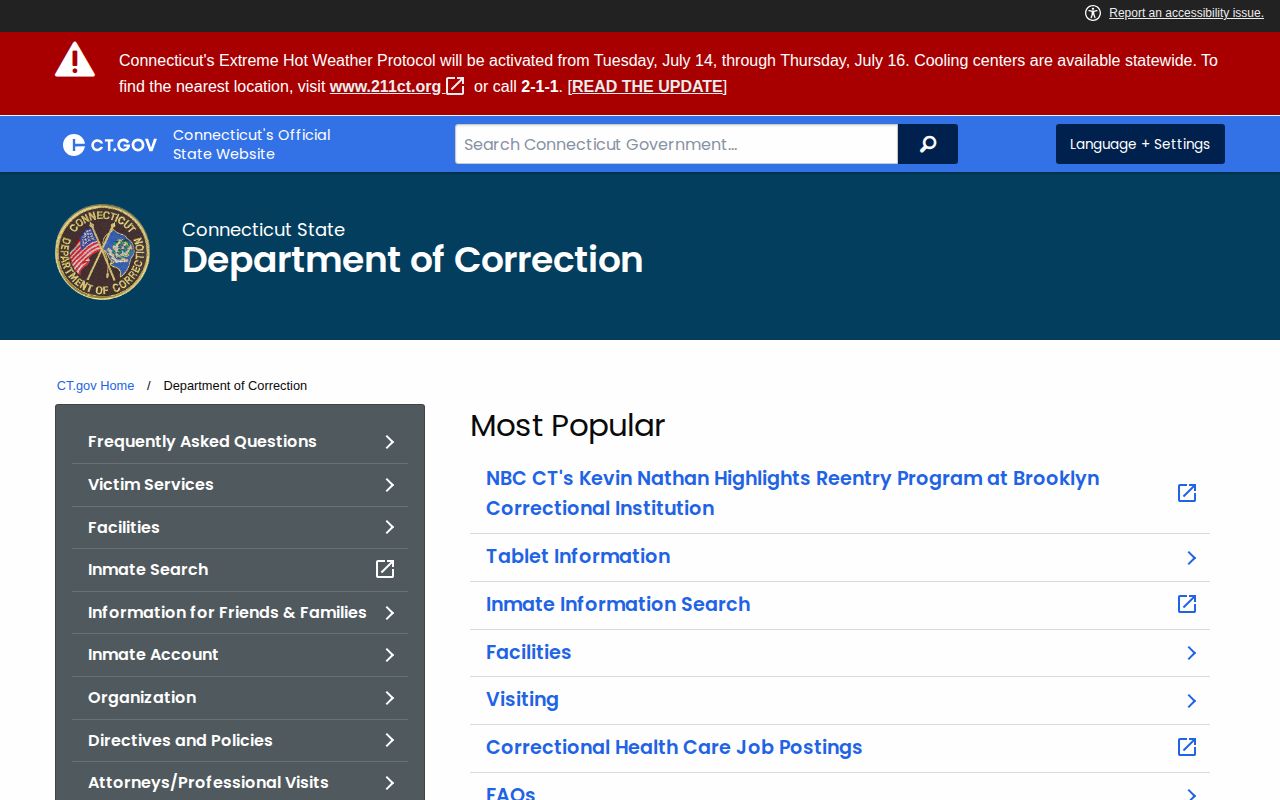
The statewide context matters because the final releasing institution may be far from West Haven even though the arrest and sentence began in the New Haven court region.
Facility pages should supply current addresses and operating details. The statewide record supplies continuity. Search and request by DOC number when possible, then verify the release reason with the sentencing docket and the agency action that ended or changed custody.
Connecticut DOC Facility Transfers
A statewide search must follow the DOC number across institutions. Facility names can change during pretrial placement, classification, sentenced custody, programs, and later moves. A West Haven or New Haven reference may disappear from the current-facility field even though the person is the same. The docket number and DOC number preserve that link.
Do not record the date of a facility move as the prison release date. A transfer continues custody unless the receiving status clearly shows community placement or another release category. When the screen is unclear, request the public facility history and release record from DOC, then compare it with VINE and the sentencing docket.
Connecticut DOC Release Then ICE
An immigration detainer may affect a small subset of state releases. A DOC record can show release from Connecticut criminal custody while ICE takes custody next. That does not mean the person returned to the community. It also does not mean every noncitizen or every missing DOC result involves ICE.
Check immigration custody only when release paperwork, counsel, VINE, the court, or another reliable agency source points to a detainer or transfer. The ICE Online Detainee Locator System searches for many adults in ICE custody. It does not replace the Connecticut sentence, DOC release, or court record.
Note: Treat ICE as a conditional downstream custody check, not as a routine part of every Connecticut DOC search.